
The Other Driver Wants to Settle Privately After a Crash: What Should You Record and Tell Your Insurer?
A practical record-and-notify guide for drivers in England.

Quick answer
You may sometimes consider a private payment for minor vehicle damage, but you should still tell your insurer and preserve the evidence before agreeing anything.
- Deal with safety, required details and any police-reporting duty first.
- Photograph the scene and damage, keep original footage, note witnesses and save every message.
- Check your policy’s notification deadline and whether the insurer’s consent is needed before negotiation or payment.
- Do not privately settle injury or possible injury, and do not assume a receipt prevents every later claim.
Pause the money discussion until the damage, policy position and remaining uncertainty are understood.
It can be hard to judge an offer while the collision is still fresh. Accident Assist Network can discuss eligible practical vehicle-damage coordination in England, subject to its Terms, but it cannot decide liability, interpret your insurance policy or give legal advice. You remain responsible for notifying your insurer.
Related page: Read Accident Assist Network’s current Terms and Conditions.
A quick private offer can feel like relief after the shock of a collision. Yet the visible mark is not the whole decision. The repair scope, vehicle safety, possible later symptoms, policy terms and the other driver’s future account may all remain uncertain. This guide separates those questions so urgency does not replace evidence.
Deal with safety and reporting before payment
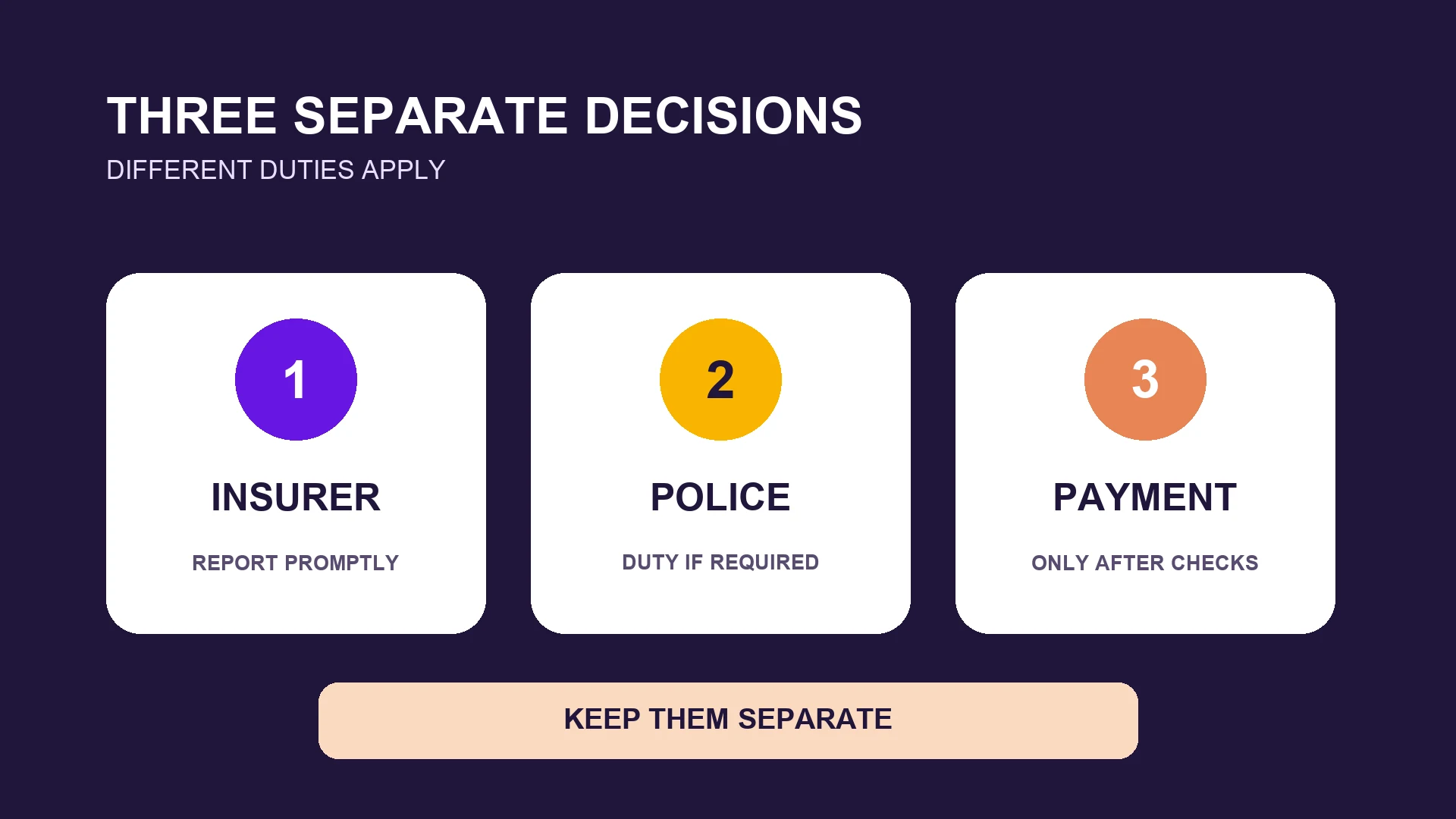
A private proposal never replaces the duties that arise from the collision. Stop, make the scene as safe as you reasonably can and exchange the required identity, vehicle and insurance details. GOV.UK’s accident guidance, Highway Code rules 286–287 and section 170 of the Road Traffic Act 1988 set out the relevant framework.
The police question is separate from the private-payment question. Police.uk’s collision guidance says a report is not normally required where details were exchanged, nobody was injured and no driving offence is alleged. Those conditions belong together. If required details were not given, GOV.UK says the incident must be reported to the police within 24 hours. Possible injury or a suspected offence changes the route too.
Stop the private discussion for now if:
- anyone is injured, feels unwell or may have an injury;
- required details are missing, refused or appear unreliable;
- there is immediate danger or a suspected driving offence;
- the vehicle may not be safe to move or drive;
- the proposal depends on secrecy, instant cash or unnecessary identity documents; or
- you have not checked what your policy requires.
Feeling fine at the scene does not prove there is no injury. NHS guidance on whiplash says symptoms may take several hours to begin. Do not privately value or settle possible injury, and do not sign wording that treats an early absence of symptoms as a final medical conclusion.
Stay calm and factual. Section 2 of the Compensation Act 2006 says an apology is not, by itself, an admission of negligence or breach of statutory duty. Your policy may still restrict admissions, negotiation or payment.
Once urgent duties are addressed, create a record that can survive disagreement later.
Build the evidence pack while facts are fresh

Your evidence pack should let someone who was not present understand what happened. The Association of British Insurers’ accident checklist supports recording driver, vehicle, witness and scene information. The Financial Ombudsman Service says photographs, notes and engineering evidence can matter in vehicle-repair disputes.
Record what is available and safe:
- People and vehicles: names, addresses, contact details, registration numbers, exchanged insurance information and the registered owner where relevant.
- Time and place: date, approximate time, exact location, direction of travel and relevant lane positions.
- Scene: wide photographs of vehicle positions, road layout, signs, markings, lighting, weather and visible debris or fluid.
- Damage: close and wider images of every affected area and the surrounding panels on both vehicles.
- Witnesses: names and contact details, plus where each person was standing or travelling; do not coach their account.
- Original media: dashcam and phone files kept in their original form, backed up before anything is overwritten or edited.
- Factual timeline: what you observed, what each person said and what happened next, clearly separated.
- Private proposal: the amount, what it was said to cover, any conditions, and the complete message trail.
- Later records: insurer reference, inspection findings, estimates, invoices, payments and new symptoms or contact.
Do not supply unnecessary identity documents. City of London Police guidance on crash-for-cash fraud identifies pressure for money and unnecessary identity-document capture as warning signs. They are not proof of fraud, but justify pausing and preserving evidence.
Use neutral descriptions. “The rear bumper has a split near the left corner” is more useful than “only cosmetic damage”. “Neither person reported symptoms at 14:20” is safer than “nobody was injured”. Record observations, not premature conclusions.
Subject to its Terms and eligibility, AAN’s published services describe coordination relating to recovery, storage, repair and replacement vehicles. That does not approve a private settlement or replace a competent assessment, insurer notification or policy consent. Keeping the practical vehicle question separate can help you avoid deciding from a surface mark alone.
Related page: Review AAN’s current vehicle-damage services.
The record explains what happened. It does not establish the final cost or the insurance position, which is why notification comes next.
Tell your insurer even if no claim is planned
The central answer is clear: tell your insurer about the collision even if you do not intend to make a claim. GOV.UK states this directly. Use the insurer’s official channel and meet the deadline in your own policy, because notification timing and consent terms differ between contracts.
Distinguish reporting an incident from asking the insurer to pay a claim. Give a neutral account, disclose the private proposal and any money or wording already discussed, then keep the reference.
Ask these policy-specific questions:
- Is consent required before negotiation, payment or repair?
- How will the incident be recorded if no insurer payment is requested?
- What evidence should I preserve or supply?
- What should I do if further damage, symptoms or a later claim appears?
A published Financial Ombudsman Service decision, DRN-1251368, provides a case-specific example of policy wording requiring prompt notice, restricting settlement negotiation without permission and allowing the insurer to control a third-party claim. It shows that such clauses can exist; it does not prove every policy is identical. Your own schedule, certificate and policy booklet control your position.
The Financial Ombudsman’s guidance on fault claims and no-claims bonuses explains that an incident may remain notification-only where no insurer payment is made, but a later third-party claim can change its status. Pricing and no-claims outcomes vary. A private payment therefore cannot be promised to protect your premium or no-claims discount.
With the insurer informed, you can test the proposal without concealing the incident or guessing what the policy permits.
Apply a five-part decision test

A private payment may sometimes be considered for minor property damage, but no authoritative universal cash threshold or official settlement form was found. Use five gates before accepting or paying.
| Decision gate | Evidence needed | Reason to pause |
|---|---|---|
| Safety and injury | Current symptoms and appropriate medical assessment where needed | Injury or possible injury should not be privately valued or settled here. |
| Damage and roadworthiness | Competent inspection and written estimate | A surface mark may not reveal the repair scope or whether the vehicle is safe. |
| Insurer notification | Reference and insurer instructions | Private payment does not remove the notification requirement. |
| Policy permission | Exact wording and insurer response | The contract may restrict negotiation, payment, admissions or repairs. |
| Pressure and future change | Traceable proposal, preserved evidence and time to consider | Secrecy, urgency or promised finality can conceal unresolved risk. |
GOV.UK’s vehicle-safety guidance says the driver remains responsible for roadworthiness and a valid MOT alone is not enough. Do not price damage from photographs or drive a possibly unsafe vehicle because the visible mark looks small.
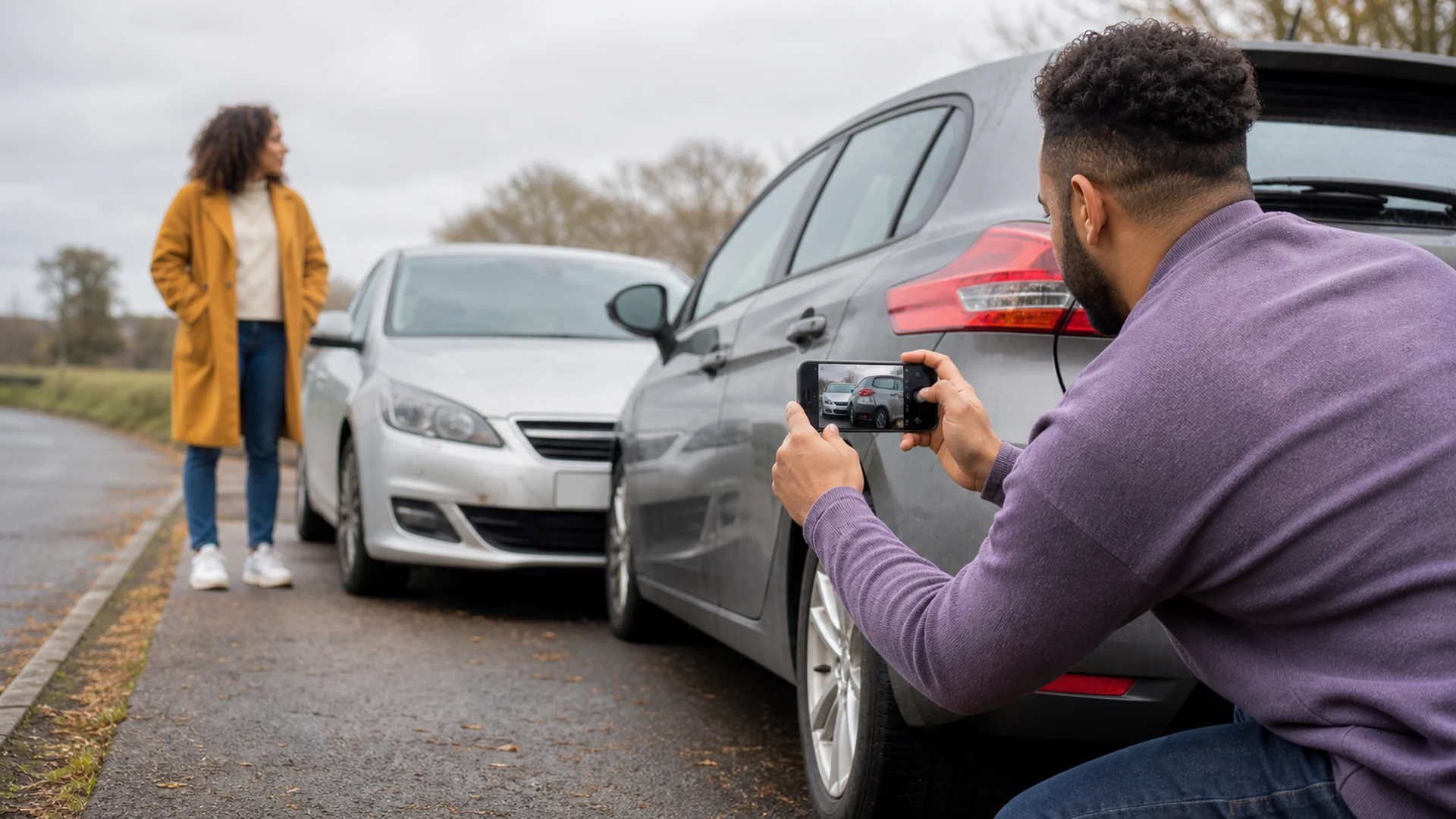
Reflection prompt: If the other driver withdrew the offer tomorrow and disputed your account, could your evidence let the insurer understand the collision without guessing?
If an essential answer remains uncertain, pause. Agreement does not turn uncertainty into safety.
No. Vehicle downtime can create pressure, but AAN does not decide liability, interpret insurance cover, negotiate a settlement or provide legal advice. It may discuss eligible practical vehicle-damage coordination in England while you remain responsible for insurer communication and for obtaining any medical or legal advice the circumstances require.
Related page: Read AAN’s general non-fault accident questions.
The decision test identifies uncertainty. The written record must preserve it honestly rather than pretending it has disappeared.
Keep records without drafting a legal release
Keep one chronological file: original scene evidence, applicable police or medical information, insurer notification, vehicle assessment, messages, payment and later developments. Do not alter the originals.
If money changes hands, record who paid whom, the amount, date, method and identified property damage. Keep the transfer reference, receipt and messages. This may evidence discussion and payment; it cannot be promised to prevent every later claim.
Do not turn a factual record into a homemade legal document. Avoid unsupported statements about fault, undiscovered damage, future symptoms or rights you do not understand. This guide supplies no “full and final” wording, settlement agreement, release template or cash threshold. If proposed wording is intended to waive legal rights, accept liability or cover injury, seek advice from a suitably qualified legal professional before signing.
Private arrangements often fail when an assumption changes: an estimate rises, a warning light appears, pain begins, a passenger alleges injury, payment is disputed or a later claim reaches the insurer. None is inevitable. Each is a reason to reject promises of certainty.
Keep these distinctions clear:
- a payment record proves a payment, not automatic legal finality;
- a repair estimate describes proposed work, not every insurance consequence;
- a notification-only record is not invisible and may change;
- an early absence of symptoms is not a final medical conclusion; and
- an AAN enquiry is not insurer notification, legal advice or insurance intermediation.
Those limits lead to a simple sequence that is easier to follow under pressure.
Your record-and-notify sequence
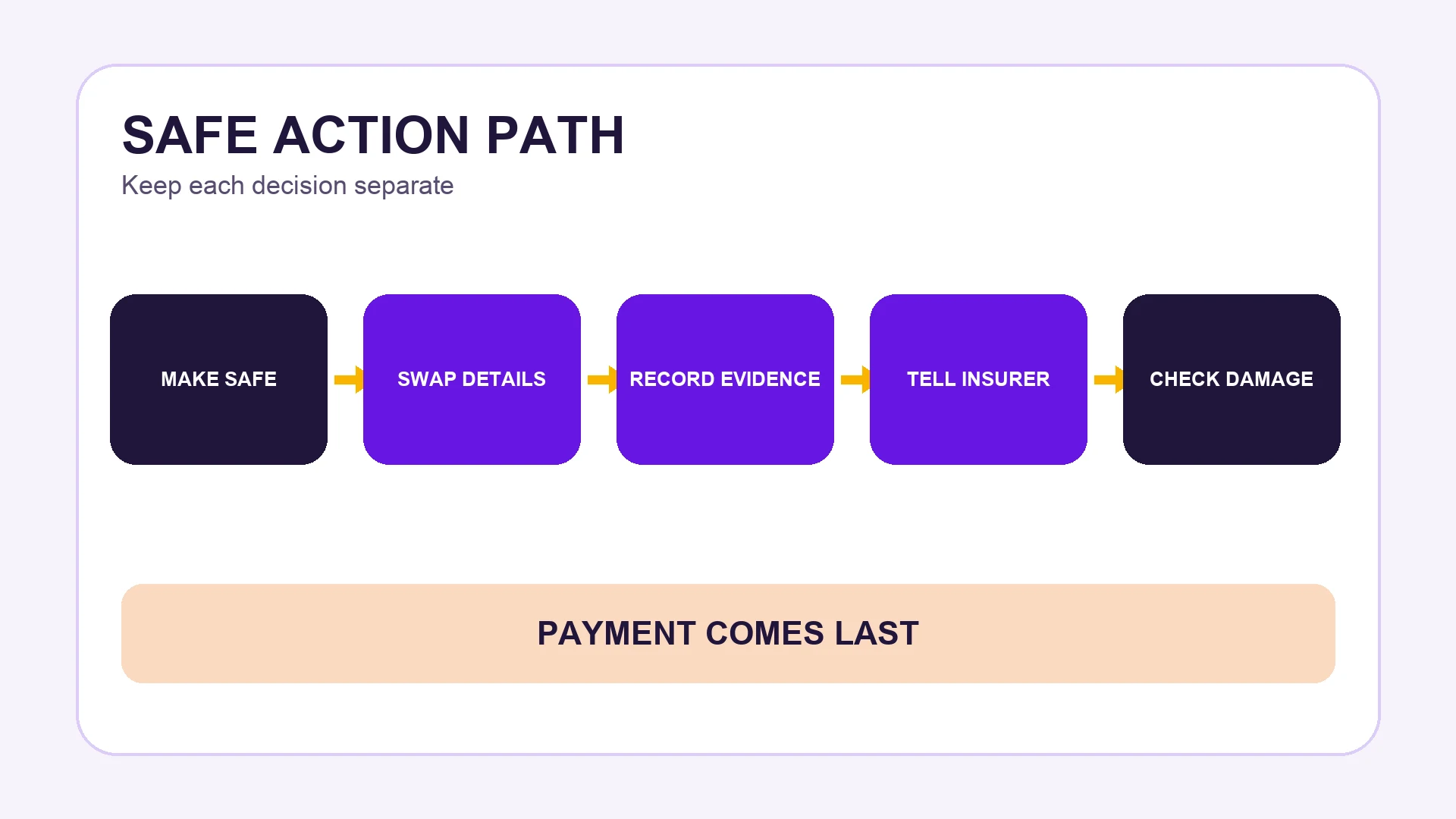
- Make safety the first gate: danger, possible injury and roadworthiness.
- Meet exchange and reporting duties under current official guidance.
- Capture evidence: people, vehicles, scene, damage, witnesses, footage, timeline and offer.
- Notify your insurer even if no claim is planned.
- Ask about consent for negotiation, payment or repair.
- Obtain a competent assessment rather than pricing visible marks.
- Keep possible injury outside the private discussion.
- Screen for pressure, fraud and unnecessary identity requests.
- Preserve messages and payment evidence without claiming finality.
- Update your insurer if damage, symptoms or claims change.
The offer may start the decision, but a defensible choice begins with safety, evidence, notification and assessment—not the amount offered.
Sources and current references
- GOV.UK — If you’re in an accident
- The Highway Code — rules 286–287
- Road Traffic Act 1988 — section 170
- Police.uk — Collisions and incidents
- Financial Ombudsman Service — Fault claims and no-claims bonuses
- Financial Ombudsman Service — Vehicle repairs
- Financial Ombudsman Service — Decision DRN-1251368
- NHS — Whiplash
- GOV.UK — Check your vehicle is safe to drive
- City of London Police — Crash-for-cash fraud
- Compensation Act 2006 — section 2
- Association of British Insurers — What to do after a car accident
- Accident Assist Network — Terms and Conditions
- Accident Assist Network — Our services
About the writer
Raheel A Rathore, Director, explains how evidence, insurer notification and vehicle assessment fit together when a private payment is proposed. This guide stays within current public sources and AAN’s published service boundary so readers can identify the right next question without being promised an outcome.
Yes. You may make an enquiry about eligible practical vehicle-damage coordination within AAN’s England boundary, subject to its Terms. You remain responsible for insurer communication, and AAN does not provide legal advice, insurance intermediation, regulated claims-management services or personal-injury handling. Review the boundary before sharing details.
Related page: Check AAN’s role and exclusions.
DISCLAIMER:
Accident Assist Network assists you after a non-fault accident by co-ordinating vehicle recovery, reputable repairs, cash-in-lieu settlements for total-loss vehicles, and like-for-like replacement hire—whether for personal use, licensed taxi work or bike—through our network of independent specialist companies across England. Your one call and we sort it all.
Because our role is one of practical facilitation rather than financial advice, we are not authorised by the Financial Conduct Authority, and our services are not covered by the Financial Ombudsman Service or the Financial Services Compensation Scheme.
Our partner companies will always endeavour to help you recover costs from the at-fault insurer; however, if that insurer delays or disputes payment you may become liable for credit services or other charges set out in your contract. Each partner company will supply its own terms and conditions in agreements. Please read every document thoroughly and, if anything is unclear, ask us—or an independent adviser—before signing. We are happy to guide you in the language you feel most comfortable with.
Need practical help in England? Call 020 4577 1120 | WhatsApp 07585 300 600
Informational FAQs
These six editorial questions arise from the research mandate and source ledger. They are not represented as observed Google People Also Ask data and are separate from the four company-authored Commercial PAA modules.
Do I have to tell my insurer if the other driver pays privately?
Yes. GOV.UK says you must tell your insurer about the accident even if you do not intend to claim. Follow the notification deadline and method in your policy, explain that private payment has been proposed and ask whether the insurer’s consent is required before you agree anything.
Do I always have to report a minor collision to the police?
No, not in every circumstance. Police.uk says a report is not normally required when details were exchanged, nobody was injured and no driving offence is alleged. Missing details, possible injury or suspected offending changes the route, so compare current official guidance with the exact facts promptly.
Can a private settlement protect my no-claims discount?
There is no guaranteed outcome. Financial Ombudsman guidance says an incident may remain notification-only where the insurer makes no payment, but a later third-party claim can change its status. Pricing and no-claims treatment vary, so ask your insurer rather than relying on the other driver’s promise.
Is a handwritten receipt enough to stop a later claim?
You should not assume so. A receipt may record what was discussed or paid, but the reviewed sources do not establish a universal form that prevents every later damage or injury claim. Obtain appropriate legal advice before signing or relying on wording intended to settle legal rights.
What if pain starts after we agreed to deal with damage privately?
Treat the symptoms as important new information. NHS guidance says whiplash symptoms can take several hours to begin. Seek appropriate medical help, tell your insurer promptly and do not attempt to value or settle injury through the private property-damage arrangement discussed in this article.
Should I pay cash at the roadside for a small scratch?
Do not pay under pressure. First preserve evidence, notify your insurer, check whether the policy permits negotiation or payment, and obtain a competent damage assessment. A visible scratch may not reveal the full repair or roadworthiness position, while urgent money demands can be a fraud warning sign.